Don't Throw the Baby Out With the Bathwater and Other Sayings
It hits your electronic mail inbox with surprising regularity: "Life in the 1500s," a collection of the incredible stories behind old sayings similar "throw the baby out with the bathroom water" and "chew the fatty." "Incredible" is the operative word. The stories are amazing; too bad they're not true. Here'due south the existent scoop behind the first set up of the expressions in this prank electronic mail.
one. To throw the infant out with the bath water
Wikimedia Commons
The Tall Tale: Baths consisted of a large tub filled with hot h2o. The man of the business firm had the privilege of the prissy clean water, so all the other sons and men, then the women and finally the children—concluding of all the babies. By and then the water was so muddy you could actually lose someone in it—hence the saying, "Don't throw the baby out with the bath water."
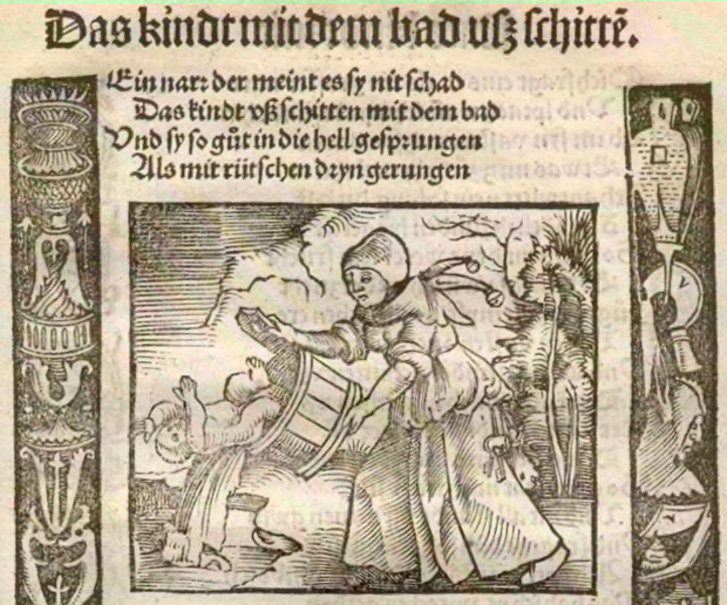
The Facts: In the 1500s, when "running water" meant the river, filling a large tub with hot water was a monumental task. A wet-cloth version of a sponge bath was all virtually people could manage. In the 19th century, English writers borrowed the German saying "Das Kind mit dem Bade ausschütten] [to throw the babe out with the bath water]." The maxim first appeared in impress in Thomas Murner's satirical work Narrenbeschwörung (Appeal to Fools) in 1512. Judging from the woodcut illustrating the saying, mothers were able to fill a tub large enough to bathe a baby, but the child could inappreciably be lost in the dirty water.
ii. To rain cats and dogs
Wikimedia Commons
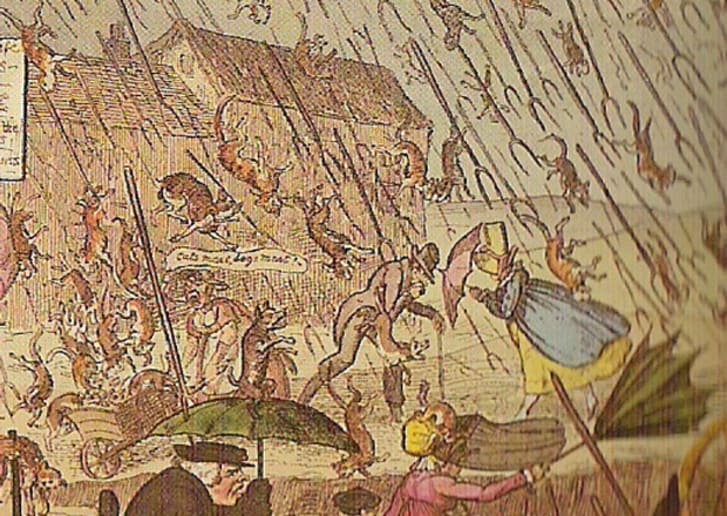
The Alpine Tale: Houses had thatched roofs—thick straw, piled high, with no wood underneath. It was the only place for animals to get warm, so all the dogs, cats, and other small animals (mice rats, and bugs) lived in the roof. When it rained it became slippery and sometimes the animals would slip and fall off the roof, hence the saying "Information technology's raining cats and dogs."
The Facts: Mice and rats (non cats and dogs) did couch into the thatch, but fifty-fifty they would have to be on peak of the thatch to slide off in the rain. Etymologists offer several theories about the origin of the phrase, which first appeared in impress in the 17th century, not the 16th:
• Information technology could refer to the well-known enmity betwixt two animals and and so allude to the fury of "going at it like cats and dogs."
• William and Mary Morris suggest that the phrase arose from the medieval belief that witches in the form of black cats rode the storms and from the association of the Norse storm god Odin with dogs and wolves, merely since the expression appeared so late, these seem unlikely sources.
• Gary Martin, writer of the Meanings and Origins section of the Phrase Finder website, states that at that place is no show for the theory that "raining cats and dogs" comes from a version of the French give-and-take catadoupe, meaning waterfall. Instead, Martin proposes that, "The much more probable source of 'raining cats and dogs' is the prosaic fact that, in the filthy streets of 17th/18th century England, heavy rain would occasionally behave forth expressionless animals and other droppings…Jonathan Swift described such an issue in his satirical poem 'A Description of a City Shower,' first published in the 1710 collection of the Tatler magazine."
• Merely and so again, Swift was noted for his flights of fancy and the phrase had been used since the mid-1600s. Possibly these elaborate backstories are free. "Raining cats and dogs" may but be an imaginative way of describing a pounding storm.
3. Dirt poor
Getty Images
The Tall Tale: The floor was dirt. Only the wealthy had something other than dirt—hence the saying "dirt poor."
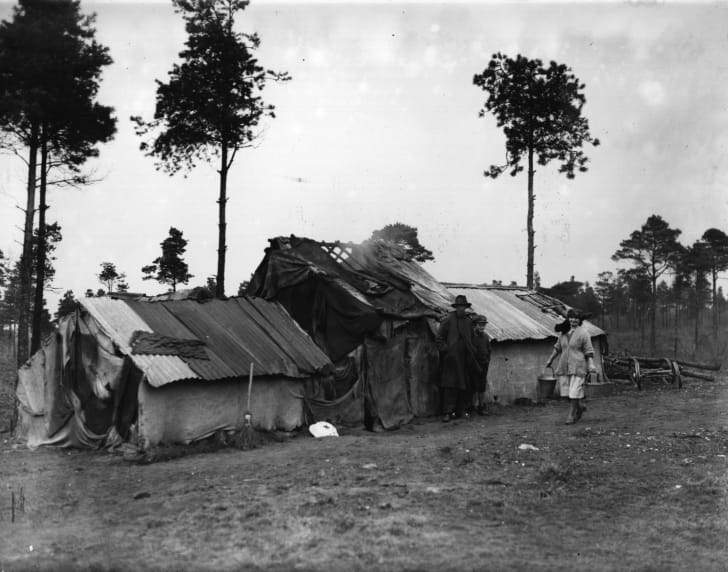
The Facts: In the simplest cottages, the floor might be packed dirt, just those who could afford them had wooden floors. "Dirt poor" is an American expression kickoff documented in the 1930s, according to the Oxford English language Dictionary, and a search of Google Books backs up the claim.
4. Threshold
The Tall Tale: The wealthy had slate floors that would get glace in the wintertime when wet, and then they spread thresh on the floor to assist continue their footing. Every bit the winter wore on, they kept adding more thresh until when you opened the door it would all start slipping outside. A piece of wood was placed in the entry fashion—hence, a "thresh hold."
The Facts: The wealthy had wooden floors. The boards were crude, so they were covered either with carpets or, yeah, rushes or reeds, but these were usually changed daily. Although in Scots dialect reeds were sometimes known equally "thresh," threshold has a different origin. Information technology comes from therscold or threscold, which is related to German dialect Drischaufel. The start element is related to thresh (in a Germanic sense, "tread"), but the origin of the 2nd element is unknown.
5. Pease porridge hot, pease porridge cold
Wikimedia Eatables
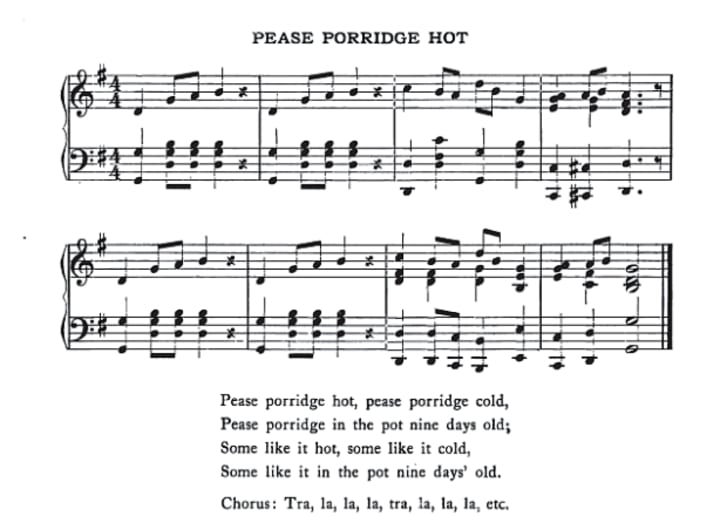
The Tale: They cooked in the kitchen with a large kettle that always hung over the fire. Every 24-hour interval they lit the fire and added things to the pot. They ate by and large vegetables and did non get much meat. They would eat the stew for dinner, leaving leftovers in the pot to become cold overnight and then start over the next day. Sometimes the stew had food in information technology that had been at that place for quite a while—hence the rhyme, "peas porridge hot, peas porridge common cold, peas porridge in the pot ix days sometime."
The Facts: OK, this one is actually true (except for the claim that anyone likes information technology cold). Pease, every bit it's often spelled in the chant, is an archaic spelling of "peas," and then pease porridge is what nosotros now call "pea soup."
6. To bring home the bacon
Getty Images
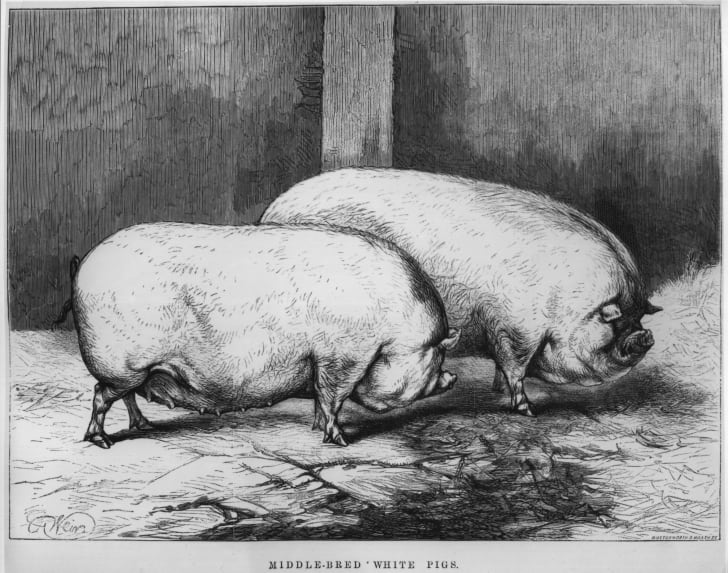
The Tall Tale: Sometimes they could obtain pork, which made them feel quite special. When visitors came over, they would hang up their salary to show off. Information technology was a sign of wealth that a homo "could bring abode the bacon."
The Facts: Some writers trace the expression "bring home the bacon" to catching the greased pig at a fair and bringing it home as a prize. Others merits the origin is in an English custom dating from the 12th century of awarding a "flitch of bacon" (side of pork) to married couples who tin can swear to non having regretted their marriage for a year and a day. Chaucer's "Wife of Bath" refers to the custom, which all the same survives in a few English villages. One problem, though: The phrase did not announced in print until 1906, when a New York newspaper quoted a telegram from the female parent of a prizefighter telling him "[Y]ou bring home the bacon." Before long many sportswriters covering battle picked up the expression.
seven. Chew the fat
Wikimedia Commons
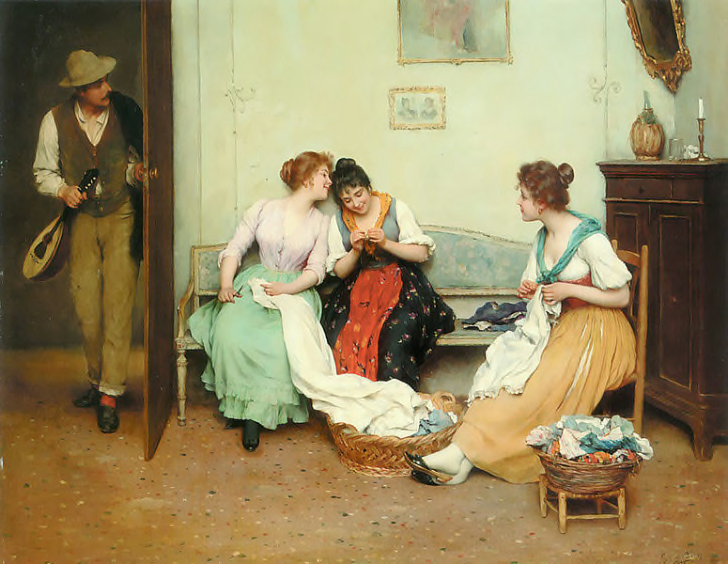
The Tall Tale: They would cut off a little [bacon] to share with guests and would all sit down around and "chew the fat."
The Facts: The Oxford English language Dictionary equates "chew the fat" with "chew the rag." Both expressions date from the late 19th century and mean to discuss a affair, especially complainingly; to reiterate an old grievance; to grumble; to contend; to talk or chat; to spin a yarn. J. Brunlees Patterson in Life in the ranks of the British Army in India and on Board a Troopship (1885), speaks of "the various diversions of whistling, singing, arguing the point, chewing the rag, or fat." In other words, "chewing the fat" is an idle exercise of the gums that produces picayune nourishment.
Sources: Domestic architecture: containing a history of the science; "Flitch of Bacon," Wikipedia; "Housing in Elizabethan England," Daily Life through History;Google Books Ngram Viewer; The Phrase Finder; Snopes.com; Morris Dictionary of Word and Phrase Origins, 1971; New Oxford American Dictionary, 2nd ed.; Oxford English Dictionary Online.
stallardsuplusentep.blogspot.com
Source: https://www.mentalfloss.com/article/55503/7-tall-tales-about-life-1500s-and-origins-phrases
0 Response to "Don't Throw the Baby Out With the Bathwater and Other Sayings"
Postar um comentário